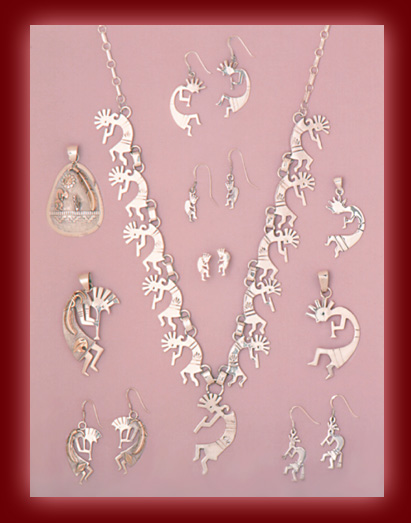
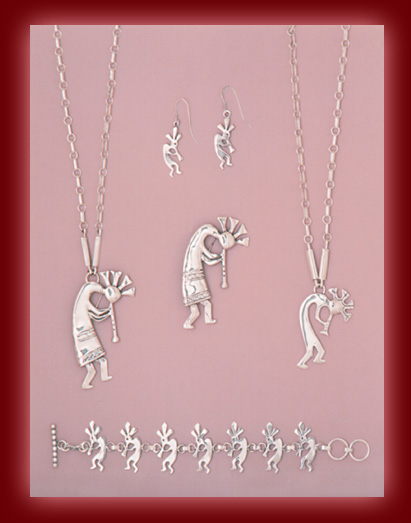
| | O The flute which is used to invoke the supernatural can be seen as carrying the message (request) to the supernatural, but simultaneously the hump or the basket might be seen as carrying gifts (of life--for example, water) to humanity from the supernatural and the flute signifying arrival of these gifts.
O Depending on the legend one choses to follow, the different characteristics are associated with different myths. Schaafsma covers this topic very well in her 1980 text, "Indian Rock Art of the Southwest" and she derives most of her information from an article by K.F. Wellmann, "Kokopelli of Indian Paleology: Hunchbacked Rain Preist, Hunting Magician, and Don Juan of the Old Southwest," published in 1970, in the Journal of the American Medical Association.
O Apparently, Kokopelli is just as important to the Hopi today, as he was in the past, he being the important rain priest, associated with the locust and found often together with the snake. Earlier interpretations of being associated with the "fire of life", as suggested by Fewkes (1903), remain inconclusive, according to Schaafsma. The phallic nature of the flute player and even the name of Kokopelli, however, appear to be recent additions, while the hump, the flute, and locust associations are much older.
O In one respect, I find it curious that no one else attempted to discuss Kokopelli; perhaps part of the reason is that this is just another example of how something sacred has been appropriated into the world of kitsch. So, it comes as no surprise that the Hopi, from what I understand, prefer to keep their religion as separate, apart, or "secret" from the contemporary world. Also, it seems important to me to realize that figures like Kokopelli deserve the same reverence (and respect) that the symbols of Christianity or Judaism receive. | |